Slim Phones vs Big Battery Phones: Which One Should You Buy?
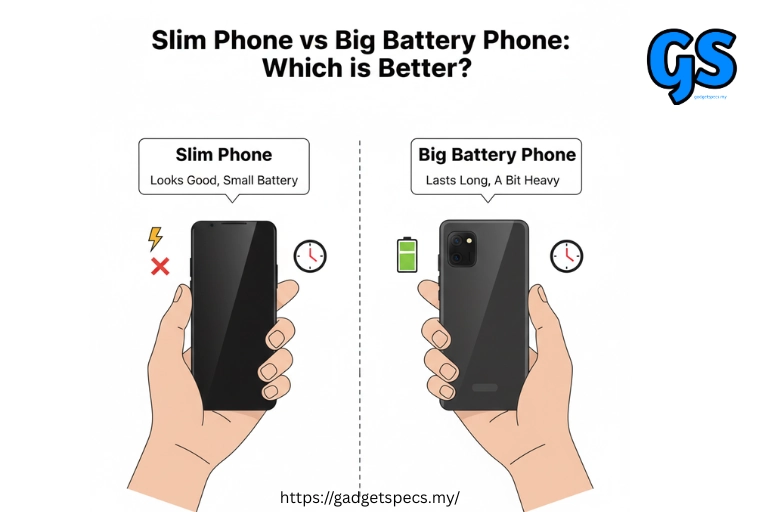
It is one of the biggest trade-offs in smartphone design — and one that every Malaysian buyer faces when shopping for a new phone in 2026. Slim phones look stunning, feel premium, and slide effortlessly into your pocket. Big battery phones last two full days, charge in under 30 minutes, and never leave you hunting for a power socket. But you almost never get both in the same phone.
This complete guide breaks down every major difference between slim phones and big battery phones — design, real-world battery life, charging speed, camera quality, gaming performance, price, and daily comfort — so you can make the right choice for your lifestyle in Malaysia.
- 🔍 Overview – The Core Trade-off
- 🎨 Design & Comfort
- 🔋 Real-World Battery Life
- ⚡ Charging Speed
- 🎮 Performance & Heating
- 📷 Camera Quality
- 🇲🇾 Malaysia-Specific Factors
- 🏆 Round-by-Round Scores
- 💜 Best Slim Phones Malaysia
- 💚 Best Big Battery Phones Malaysia
- 🎯 Which Phone Type Suits You?
- 👤 User Profiles & Recommendations
- ❓ FAQ
- 🏆 Final Verdict
🔍 Overview – The Core Trade-off Explained
Here is the fundamental physics problem every smartphone engineer faces: battery capacity requires physical space. A larger battery means a thicker phone. A thinner phone means a smaller battery. There is no magic way around this — it is simply how lithium-ion battery technology works.
Phone makers have tried everything to bridge this gap — new battery chemistry, silicon-carbon anodes, stacked cell designs — and they have made real progress. But in 2026, the trade-off remains very real and very visible when you compare the phones on either end of the spectrum. A phone like the iPhone 17 Air at 5.5mm cannot physically contain the battery of a Vivo X500 Pro Max with its 6,500mAh cell.
- ✅ Looks and feels premium
- ✅ Fits easily in any pocket
- ✅ Lighter and more comfortable to hold
- ✅ Easier one-hand use
- ✅ Often uses latest design language
- ✅ Better for dress code / professional image
- ⚠️ Battery typically 3,500–4,500mAh
- ⚠️ May need charging mid-day for heavy users
- ⚠️ Usually charges at 25W–45W only
- ⚠️ May throttle faster due to less cooling space
- ✅ 1.5–2+ days battery per charge
- ✅ Massive peace of mind — no charging anxiety
- ✅ 80W–120W ultra-fast charging
- ✅ Better sustained performance (more cooling space)
- ✅ Often better value for money
- ✅ Great for travel and outdoor use
- ⚠️ Thicker profile — 8mm to 10mm+
- ⚠️ Heavier — usually 210g to 240g
- ⚠️ Less elegant in hand
- ⚠️ May feel bulky in tight pockets
🎨 Round 1 — Design, Comfort & Daily Feel
Design is where slim phones win most convincingly — and it is often the first reason people choose them. A phone that is 5.5mm to 7mm thin genuinely feels different in the hand compared to an 8.5mm or 10mm thick battery phone. It feels lighter, more refined, and slides in and out of pockets with satisfying ease — especially in Malaysia where many people use slim-fit jeans and business attire that does not accommodate bulky phones well.
| Design Factor | Slim Phone (≤7mm) | Big Battery Phone (8mm+) | Winner |
|---|---|---|---|
| Thickness | 5.5mm – 7.0mm — feels impossibly thin | 8.0mm – 10.5mm — noticeably thicker | Slim Wins |
| Weight | 155g – 185g — light and effortless | 200g – 240g — noticeably heavier | Slim Wins |
| Pocket Feel | Slides in perfectly — barely noticeable | Noticeable in pocket — especially tight jeans | Slim Wins |
| One-Hand Use | Easier — lighter and thinner to grip | Harder — heavier, may be wider too | Slim Wins |
| Premium Feel | Feels expensive — thin = luxury in phones | Feels solid — but can feel chunky | Slim Wins |
| Durability | Thinner = less structural rigidity | Thicker body = stronger and more rigid | Battery Wins |
| Drop Resistance | Thinner glass = cracks easier | More space for internal protection | Battery Wins |
| Long-Session Comfort | Light = comfortable for hours | Heavy = hand/wrist fatigue on long calls | Slim Wins |
Slim phones win the design and comfort round convincingly. The combination of lower weight, reduced thickness, and better pocket ergonomics makes slim phones genuinely more pleasant to carry and use every day. For Malaysians who commute, work in offices, or attend meetings — a slim phone simply looks and feels more appropriate. However, the big battery phone’s structural advantage should not be dismissed — a thicker, heavier frame genuinely absorbs drops better.
🔋 Round 2 — Real-World Battery Life in Malaysia
This is where big battery phones dominate — and it is not even close. Malaysia’s climate, habits, and infrastructure make battery life especially important compared to many other countries. High screen brightness needed under the tropical sun, heavy WhatsApp and social media usage, and sometimes unreliable access to charging points (think KL traffic jams, long outstation drives, or outdoor events) all drain batteries faster than in temperate climates.
| Usage Scenario | Slim Phone (4,000mAh) | Big Battery Phone (6,000mAh) | Difference |
|---|---|---|---|
| Light Use (calls, messaging) | Full day (12–14 hrs) | 2 full days | +100% more |
| Moderate Use (social media, maps) | 6–8 hrs screen-on | 10–14 hrs screen-on | +60–75% more |
| Heavy Use (gaming, video) | 4–5 hrs before charge | 7–9 hrs before charge | +60–80% more |
| KL Traffic Navigation (GPS) | Drains fast — may need power bank | Handles hours of GPS easily | Battery wins clearly |
| Outdoor Event (full brightness) | Struggles after 4–5 hours | Lasts all day comfortably | Battery wins clearly |
| Travel / No Charger Access | Need power bank or adapter | 2-day backup without charger | Battery wins clearly |
| Video Streaming (Netflix) | ~12–16 hours video | ~22–28 hours video | +70% more |
There is no meaningful contest here. A 6,000mAh battery phone simply lasts dramatically longer than a 4,000mAh slim phone in every single usage scenario. For most Malaysian users who are away from home chargers for 10–14 hours daily — commuting, working, eating out, and socialising — the big battery phone is the practical choice that eliminates the daily stress of battery anxiety. The question is whether that practical advantage is worth the design trade-off. For more context, see our best phones with 6,000mAh battery and best phones for battery life in Malaysia guides.
- Tropical sun = high brightness: Malaysian users typically run displays at 70–100% brightness outdoors — draining batteries significantly faster than in Europe or Japan
- Grab + Waze usage: GPS + screen-on for 30–60 minutes in KL traffic can drain 20–30% battery per trip — twice daily
- WhatsApp culture: Malaysian WhatsApp groups are notoriously active — constant notifications and media loading adds up
- Limited charging at some workplaces: Many Malaysians cannot charge at desks during working hours — needing a phone that lasts the whole day
- Weekend activities: Hiking in Cameron Highlands, Penang street food walks, or Langkawi beach days — no charger access for 8–12 hours
⚡ Round 3 — Charging Speed
Ironically, big battery phones often charge faster than slim phones — despite having more capacity to fill. This is because slim phones use slower charging speeds to manage heat in their thin bodies, while big battery phones (especially Chinese Android brands) use aggressive 80W to 120W fast charging technology that refills even a 6,000mAh battery in under 45 minutes. For the full context, see our fastest charging smartphones in Malaysia guide.
The data is clear and somewhat counterintuitive: big battery phones charge faster than slim phones. The iQOO 12’s 120W charging fills a 5,000mAh battery in 22 minutes — while the Samsung Galaxy S26’s 25W takes 80 minutes to fill a smaller 4,000mAh cell. The Honor Magic 8 Pro fills 5,850mAh in 33 minutes — faster than the slim Samsung S26 fills its 4,000mAh battery. For Malaysians who do need to charge during the day, big battery phones do it faster and need it less often. See our flagship phones that charge in under 20 minutes and best fast charging cables and adapters in Malaysia.
Not necessarily. While Apple’s MagSafe and Samsung’s wireless charging are well-marketed on slim flagships, some big battery phones offer faster wireless charging than slim phones charge with a cable. The Honor Magic 8 Pro supports 80W wireless charging — faster wirelessly than Samsung Galaxy S26’s 25W wired charging. For wireless charging options, see our best phones with wireless charging and best phones with reverse wireless charging guides.
🎮 Round 4 — Performance & Thermal Management
Both slim phones and big battery phones can use the same flagship chips — the Snapdragon 8 Elite Gen 2 or Dimensity 9300 — so raw performance is not inherently different. However, thermal management is where the physical size matters. A thicker phone has more internal space for heat sinks, vapour chambers, and graphite sheets — allowing it to sustain peak performance longer before thermal throttling kicks in.
| Performance Factor | Slim Phone | Big Battery Phone | Winner |
|---|---|---|---|
| Peak Performance (AnTuTu) | Same — same chip available in both | Same — same chip available in both | Tie |
| Sustained Gaming (30 min+) | Throttles sooner — less cooling space | Sustains longer — better cooling | Battery Wins |
| Phone Temperature Gaming | Gets warmer faster in Malaysia heat | Runs cooler — more thermal mass | Battery Wins |
| Daily Task Speed | Identical — chip determines this | Identical — chip determines this | Tie |
| Gaming Display (Hz) | Often 120Hz — limited by slim design | Often 120–144Hz + better sustained | Battery Slight Edge |
| Multitasking (RAM) | Same — RAM is independent of size | Same — RAM is independent of size | Tie |
Malaysia’s average temperature of 28–35°C means your phone’s ambient operating environment is already significantly warmer than in Korea, Japan, or Europe where most phones are tested. A slim phone with limited internal cooling space will thermal throttle faster in Malaysian conditions — dropping GPU performance by 20–40% during extended gaming sessions. Big battery phones with larger vapour chambers handle this much better.
For Malaysian gamers specifically, see our best gaming phones in Malaysia, best phones with active cooling for gaming, and how to cool down your phone fast in Malaysia.
📷 Round 5 — Camera Quality
Camera quality is primarily determined by the sensor size, lens quality, and image processing software — not the phone’s thickness directly. However, there is an indirect relationship: thicker phones can accommodate larger sensors and more complex optical zoom systems (like periscope telephoto lenses) that require physical depth. Some of the best camera phones in Malaysia — the Vivo X100 Pro, OPPO Find X7 Ultra, and Honor Magic 8 Pro — are on the thicker side precisely because they house larger sensors and periscope zoom.
| Camera Factor | Slim Phone | Big Battery Phone | Winner |
|---|---|---|---|
| Main Sensor Size | Limited by body thickness | Can fit larger sensors | Battery Phone Edge |
| Periscope Telephoto | Hard to fit — needs depth | Easier to accommodate | Battery Wins |
| Selfie Camera | Comparable — same tech fits thin | Comparable — same tech | Tie |
| Flagship Camera Partnership | Apple (iPhone) has best slim camera | Hasselblad, Zeiss, Leica on bigger phones | Depends on Brand |
| Video Stabilisation | OIS limited by thin body | More space for OIS mechanism | Battery Phone Edge |
| Low-Light Photography | Decent — depends on brand | Often better — larger sensors | Battery Phone Edge |
See our dedicated camera guides: best camera phones in Malaysia, best phones for photography lovers, best periscope zoom camera phones, and best phones for vlogging in Malaysia.
🇲🇾 Round 6 — Malaysia-Specific Factors
Malaysia has specific usage patterns, climate conditions, and lifestyle factors that make the slim vs battery choice different here compared to buyers in colder countries. Understanding these factors is crucial for making the right decision.
| Malaysia Factor | Slim Phone | Big Battery Phone | Advantage |
|---|---|---|---|
| Hot Climate (28–38°C daily) | Heats up faster — poor thermal mass | Better sustained cooling | Battery Wins |
| Long Commutes (KL / PJ / JB) | May die before home | Lasts full commute + more | Battery Wins |
| Grab / Touch ‘n Go NFC | NFC available on slim flagships | NFC available on most big battery phones | Tie |
| Rain / Monsoon Season | IP68 on most slim flagships | IP68/69 on most big battery flagships | Tie |
| Office / Formal Environment | Slim looks professional | Thicker looks more casual | Slim Wins |
| Outstation / Highway Trips | Need power bank — stressful | 2-day backup — no anxiety | Battery Wins |
| Price vs Performance | Premium price for slim design | Better specs for less money | Battery Wins |
| Resale Value (MY Market) | Apple/Samsung slim holds value | Chinese brands depreciate faster | Slim Wins |
When you factor in Malaysia’s specific conditions — hot weather that heats phones faster, long KL commutes that drain batteries, outdoor activities without charging access, and the exceptionally good value of Chinese big battery phones — the big battery phone is the more practical choice for the majority of Malaysian smartphone users in 2026.
The exception is professionals who carry a power bank, have office charging access, or prioritise device image — for them, slim phones make more sense. For more Malaysia-specific advice, see our complete smartphone buying guide Malaysia and things to check before buying a smartphone.
🏆 Round-by-Round Scorecard
📊 Final Score
💜 Best Slim Phones in Malaysia 2026
If slim design and premium feel is your priority, here are the best slim phones available in Malaysia in 2026. For more options, see our best compact smartphones in Malaysia and most user-friendly smartphones guides.
💚 Best Big Battery Phones in Malaysia 2026
If maximum battery life and charging speed is your priority, here are the best big battery phones available in Malaysia in 2026. For more options, see our best phones with 6,000mAh battery and 7,000mAh battery smartphones guides.
Light user with charging access — slim phone suits you perfectly. Consider Samsung Galaxy S26 or S26+.
Heavy user away from chargers — big battery phone is the practical choice. Consider Honor Magic 8 Pro or Realme 16 Pro+.
👤 User Profiles – Which Phone Type Suits You?
✅ Quick Summary — Slim vs Big Battery Pros & Cons
- Looks and feels premium
- Fits comfortably in any pocket
- Lightweight for all-day carry
- Professional image in meetings
- Better resale value (Samsung/Apple)
- 7-year software updates (Samsung)
- Smaller battery — may need mid-day charge
- Slower charging (25W–45W typical)
- Throttles faster in Malaysia heat
- Limited sensor/camera space
- Often more expensive for specs
- 1.5–2 days battery — no anxiety
- 80W–120W ultra-fast charging
- Better value for money
- Better camera potential (larger sensors)
- Cooler sustained gaming performance
- Perfect for Malaysian lifestyle
- Thicker — less premium feel
- Heavier — hand fatigue possible
- Bulky in tight pockets
- Fewer software update years
- Lower resale value typically
❓ Frequently Asked Questions
Is a slim phone worth buying if battery life is poor?
It depends entirely on your lifestyle. If you have easy access to chargers throughout the day — at your desk, in your car, at cafes — a slim phone with a smaller battery is perfectly adequate. If you spend 10–14 hours away from chargers daily — commuting, fieldwork, outdoor activities — a big battery phone is the practical choice. For Malaysian lifestyles, we recommend honestly assessing how often your current phone dies before you get home. See our complete smartphone buying guide for Malaysia.
Can I get a slim phone with a big battery?
In 2026, some phones are getting closer — but true “slim AND big battery” phones are rare and very expensive. Silicon-carbon batteries (like those in some Xiaomi and Vivo flagships) allow slightly higher capacity in thinner bodies — for example, a 5,000mAh battery in a 7.5mm phone. But a phone like the iPhone 17 Air at 5.5mm still has only ~3,500mAh. The trade-off has not been solved — it has been narrowed. See our slim phones vs big battery phones guide and does refresh rate affect battery life for related context.
Which is better for gaming — slim or big battery phone?
Big battery phones are better for gaming — for two reasons: larger batteries last longer during gaming sessions, and thicker bodies have more space for cooling systems that prevent thermal throttling. In Malaysia’s hot climate, this matters even more — a slim phone in 35°C Malaysian heat may throttle significantly during a 30-minute Mobile Legends session. See our best gaming phones in Malaysia and best phones with active cooling for gaming guides.
Do big battery phones charge slower because they have more capacity?
Not necessarily — and often the opposite is true. While a bigger battery does take more energy to fill, big battery phones (especially Chinese Android brands) use aggressive 80W–120W fast charging technology that fills their large batteries faster than slim phones charge smaller ones. The iQOO 12 fills 5,000mAh in 22 minutes. The iPhone 17 Air takes 90 minutes to fill ~3,500mAh. For more, see our fastest charging smartphones in Malaysia guide.
Which has better cameras — slim or big battery phones?
Generally, big battery phones have better camera hardware because their thicker bodies can accommodate larger sensors and periscope zoom systems. The best camera phones in Malaysia — Vivo X100 Pro, OPPO Find X7 Ultra, Honor Magic 8 Pro — are all on the thicker side. Apple iPhone is the notable exception — excellent cameras in a slim body, but at premium Malaysian prices. See our best camera phones in Malaysia and ultra-wide vs telephoto camera guide.
What is the best phone under RM 3,000 for battery life in Malaysia?
The best battery life phones under RM 3,000 in Malaysia include:
- Realme 16 Pro+ (RM ~1,999): 6,000mAh + 80W — best value battery phone
- iQOO 12 (RM ~2,599): 5,000mAh + 120W — fastest charging under RM 3,000
- Vivo X100 (RM ~2,799): 5,000mAh + 120W + Zeiss cameras
🏆 Final Verdict – Which Should You Buy in Malaysia 2026?
For the majority of Malaysian smartphone buyers, a big battery phone is the more practical and better-value choice in 2026. Malaysia’s hot climate, long commutes, heavy WhatsApp and social media culture, and outdoor lifestyle all favour phones with large batteries and fast charging.
Big battery phones also offer better value for money — more camera hardware, larger displays, faster charging, all at lower prices than equivalent slim flagships.
Choose a Slim Phone if: You have easy charging access all day, you prioritise professional image, you value resale value, or you are deeply invested in Samsung or Apple ecosystems.
Choose a Big Battery Phone if: You spend long hours away from chargers, you game regularly, you travel often, you want the best camera per ringgit, or you simply want maximum performance for your money.
- Best Slim Phone Malaysia: Samsung Galaxy S26+ — best balance of slim design and battery (4,900mAh + 45W)
- Best Big Battery Flagship: Honor Magic 8 Pro — 5,850mAh + 100W + Snapdragon 8 Elite Gen 2 at RM 3,799
- Best Big Battery Value: Realme 16 Pro+ — 6,000mAh + 80W at just RM 1,999
- Best for Gamers: iQOO 12 — 120W charging + 144Hz + 5,000mAh at RM 2,599
- → Best Phones for Battery Life in Malaysia
- → Best Compact Smartphones in Malaysia
- → Fastest Charging Smartphones in Malaysia
- → Best Phones with 6,000mAh Battery
- → 7,000mAh Battery Smartphones Guide
- → Samsung Galaxy S26 – Full Review
- → Samsung Galaxy S26+ – Full Review
- → Honor Magic 8 Pro – Full Review
- → Realme 16 Pro+ – Full Review
- → Vivo X500 Pro Max – Full Review
- → Best Gaming Phones in Malaysia
- → Best Value for Money Smartphones
- → Best Android Phones in Malaysia 2026
- → iPhone vs Android – Which is Best for You?
- → Complete Smartphone Buying Guide Malaysia
- → Common Smartphone Buying Mistakes
- → Things to Check Before Buying a Smartphone
- → Does Refresh Rate Affect Battery Life?