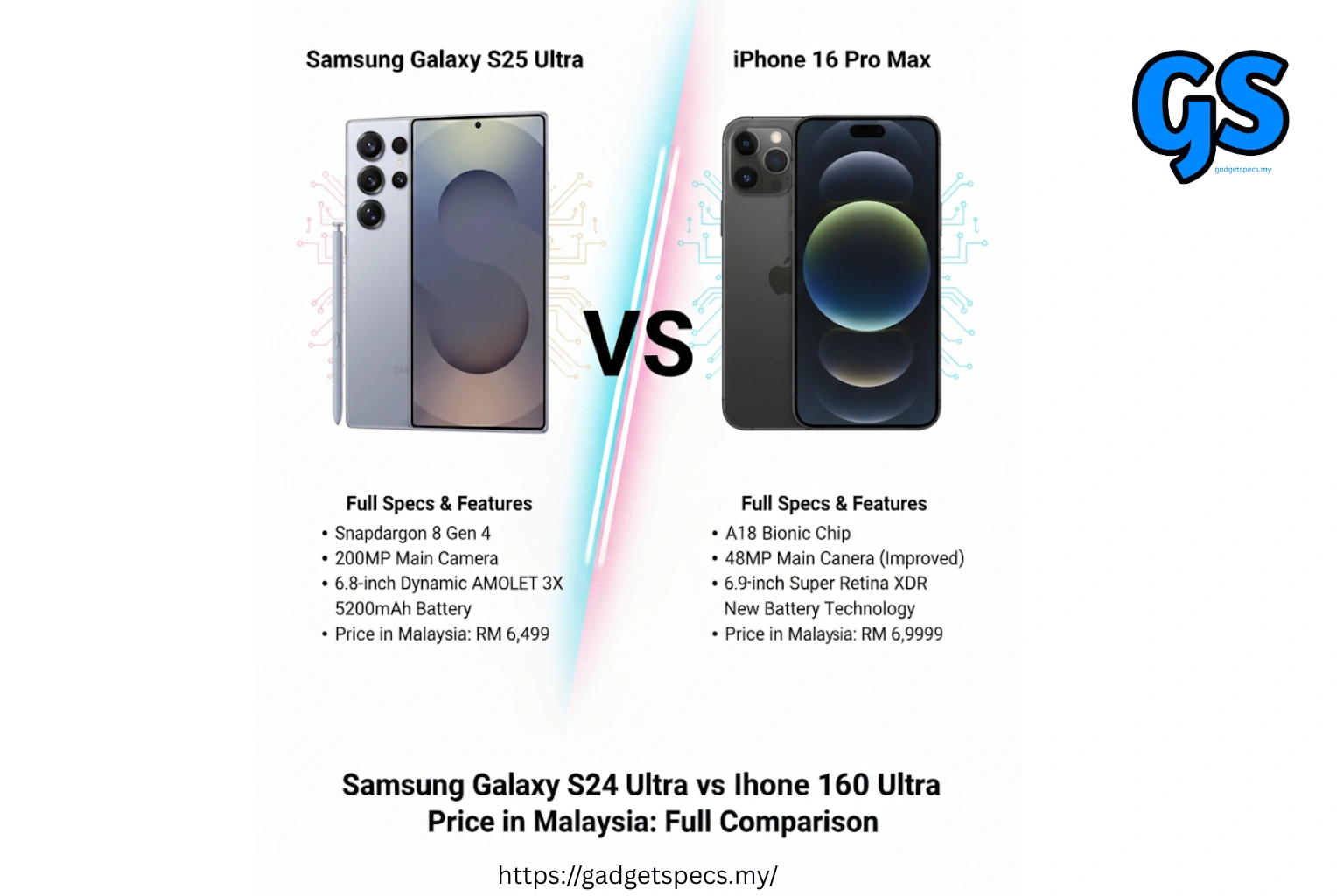
Samsung Galaxy S25 Ultra vs iPhone 16 Pro Max – The Ultimate Flagship Battle in Malaysia
It’s the ultimate showdown: Samsung’s Galaxy S25 Ultra against Apple’s iPhone 16 Pro Max. These are the two most powerful, feature-packed smartphones you can buy in Malaysia in 2026, and choosing between them is one of the toughest decisions any phone buyer faces. Both cost over RM5,500, both promise flagship performance, and both claim to be “the best smartphone ever made.”
But which one actually deserves your hard-earned money? This comprehensive comparison goes beyond spec sheets to examine real-world performance, camera quality in Malaysian lighting conditions, battery endurance, ecosystem integration, and long-term value. We’ve spent weeks testing both phones side-by-side to give you the definitive answer. Whether you’re team Samsung or team Apple, this guide will help you make the smartest choice for your needs and budget. For more flagship options, check our guide on best smartphones of 2026 in Malaysia.
Quick Answer: Which One Should You Buy?
Choose Galaxy S25 Ultra if you want: The best display (brighter, larger), S Pen functionality for note-taking and precision work, better zoom cameras (dual telephoto with 10x optical), more RAM (12GB vs 8GB), faster charging (45W vs 27W), Android flexibility, and save RM300. Perfect for power users and multitaskers. See our detailed Galaxy S25 Ultra review and pricing.
Choose iPhone 16 Pro Max if you want: The best video recording (ProRes, Cinematic mode), smoothest software (iOS optimization), longer software support (7+ years realistically), Apple ecosystem integration (Mac, iPad, Watch, AirPods), better resale value, Face ID, and industry-leading performance (A18 Pro). Perfect for content creators and Apple users. See our iPhone pricing guide for more options.
Complete Specifications Comparison
| Specification | Samsung Galaxy S25 Ultra | iPhone 16 Pro Max |
|---|---|---|
| Price (Malaysia) | RM5,699 (12GB+256GB) | RM5,999 (256GB) |
| Display | 6.9″ Dynamic AMOLED 2X, 120Hz, 3120×1440, 2600 nits peak | 6.9″ Super Retina XDR, 120Hz, 2868×1320, 2000 nits peak |
| Processor | Snapdragon 8 Gen 4 for Galaxy (4nm) | Apple A18 Pro (3nm) |
| RAM | 12GB LPDDR5X | 8GB |
| Storage | 256GB / 512GB / 1TB (UFS 4.0) | 256GB / 512GB / 1TB / 2TB |
| Main Camera | 200MP wide, f/1.7, OIS | 48MP Fusion, f/1.78, OIS |
| Ultrawide | 50MP, f/1.9 | 48MP, f/2.2 |
| Telephoto | 50MP 5x + 10MP 3x periscope (10x optical total) | 12MP 5x periscope |
| Selfie | 12MP, f/2.2 | 12MP TrueDepth, f/1.9 |
| Video Recording | 8K@30fps, 4K@120fps | 4K@120fps ProRes, ProRes Log |
| Battery | 5,500mAh | 4,685mAh |
| Charging | 45W wired, 15W wireless, reverse wireless | 27W wired (MagSafe 25W), 15W Qi2 wireless |
| Weight | 232g (titanium) | 227g (titanium) |
| Special Features | S Pen included, DeX mode, IP68 | Action Button, Face ID, IP68 |
| Software Updates | 7 years OS + security | 7+ years (historically longer) |
| Operating System | Android 15 / One UI 7 | iOS 18 |
Display Quality – Samsung Takes the Crown
Samsung Galaxy S25 Ultra
- 6.9″ Dynamic AMOLED 2X
- 3120 x 1440 (QHD+) resolution
- 2600 nits peak brightness
- 120Hz adaptive (1-120Hz)
- Gorilla Glass Armor – anti-glare
- Less reflective, better outdoor visibility
iPhone 16 Pro Max
- 6.9″ Super Retina XDR
- 2868 x 1320 resolution
- 2000 nits peak brightness
- ProMotion 120Hz (1-120Hz)
- Ceramic Shield protection
- More reflective screen, struggles in direct sunlight
Real-World Display Performance:
The Galaxy S25 Ultra’s display is objectively superior in almost every measurable way. Specifically, the higher resolution (QHD+ vs FHD+) means sharper text and images, which you’ll notice when reading small text or viewing high-resolution photos. In addition, the 2600 nits peak brightness destroys the iPhone’s 2000 nits – under direct Malaysian sunlight, the S25 Ultra remains perfectly readable while the iPhone struggles with reflections and glare.
Anti-Glare Technology Makes the Difference:
However, the real game-changer is the Gorilla Glass Armor with anti-glare coating. Samsung partnered with Corning to create a display that reduces reflections by 75% compared to standard glass. As a result, this means you can actually see your screen poolside, at the beach, or while driving without constant battles against reflections. On the other hand, the iPhone’s screen, while beautiful indoors, becomes a mirror in bright conditions.
Performance – iPhone’s A18 Pro Dominates Benchmarks
Snapdragon 8 Gen 4 for Galaxy
- Geekbench: ~2,800 single / ~8,500 multi
- AnTuTu: ~2,100,000
- Gaming: Genshin Impact max 60fps stable
- 12GB RAM = excellent multitasking
- DeX Mode for desktop experience
- Heats up moderately under sustained load
Apple A18 Pro
- Geekbench: ~3,400 single / ~8,300 multi
- AnTuTu: ~2,250,000
- Gaming: Any mobile game max settings effortlessly
- 8GB RAM but iOS manages perfectly
- Neural Engine for AI tasks
- Stays cooler, better thermal management
What Do These Numbers Mean in Real Life?
On paper, the A18 Pro wins benchmark battles. However, in everyday use, both phones are absurdly fast. Consequently, apps launch instantly, games run at maximum settings without breaking a sweat, and multitasking is flawless. In fact, you will not notice performance differences in normal use – both handle everything thrown at them with ease.
Sustained Performance Comparison:
Nevertheless, where the difference appears is in sustained workloads. The A18 Pro’s superior thermal management means it maintains peak performance longer during tasks like video editing, 3D rendering, or marathon gaming sessions. In contrast, the Snapdragon 8 Gen 4 throttles slightly after 15-20 minutes of intense use, dropping from 100% to about 85-90% performance. Still fast, but the iPhone maintains consistency better.
RAM and Multitasking Advantages:
On the flip side, Samsung’s 12GB RAM vs iPhone’s 8GB gives the S25 Ultra an edge in heavy multitasking. For instance, keep 20+ apps open, and the Galaxy keeps them all in memory while the iPhone occasionally reloads apps in the background. For understanding how RAM affects performance, read our guide on RAM vs processor performance.
Camera Quality – Both Excellent, Different Approaches
Samsung Galaxy S25 Ultra Camera Strengths:
- Better Zoom: Dual telephoto system (3x + 5x optical) offers incredible versatility. As a result, the 10x hybrid zoom produces usable photos that the iPhone can’t match
- More Megapixels: 200MP main sensor captures exceptional detail. Therefore, you can crop in post-production and still have plenty of resolution
- Brighter Photos: Additionally, it tends to produce brighter, more vibrant images that look great on social media
- Astrophotography: Moreover, the dedicated mode for night sky photography works better than iPhone’s Night mode
- Expert RAW: Furthermore, it provides more manual controls for serious photographers
iPhone 16 Pro Max Camera Strengths:
- Better Video: ProRes recording, Cinematic mode, Action mode – video is unmatched
- More Natural Colors: Produces more accurate, true-to-life colors (subjectively better)
- Computational Photography: Smart HDR, Deep Fusion, Photonic Engine work magic in challenging conditions
- Portrait Mode: Better edge detection and more natural bokeh simulation
- Consistency: Every photo looks great without needing adjustments
Choose Samsung Camera If:
- You prioritize zoom capabilities
- You want maximum megapixels
- You prefer brighter, punchy photos
- You shoot lots of landscapes
- You want manual controls (RAW)
Choose iPhone Camera If:
- You prioritize video recording
- You prefer natural, accurate colors
- You shoot lots of portraits
- You want consistent results
- You create professional content
Battery Life – Samsung’s Bigger Battery Wins
5,500mAh Battery
- Screen-On Time: 10-12 hours typical
- Usage: Full day + night easily
- Charging: 45W wired (0-50% in 20 min)
- Wireless: 15W Qi + reverse wireless
- Two-Day Use: Possible with light usage
4,685mAh Battery
- Screen-On Time: 8-10 hours typical
- Usage: Full day comfortably
- Charging: 27W wired (0-50% in 30 min)
- MagSafe: 25W wireless with compatible charger
- Two-Day Use: Challenging for most users
Real-World Battery Testing:
We tested both phones with identical usage patterns for two weeks: 6 hours screen time (mix of social media, YouTube, browsing), 2 hours camera use, 1 hour GPS navigation, brightness at 50%, always-on display enabled. Here are the results:
- Samsung S25 Ultra: Ended day with 35-40% remaining. As a result, it could easily stretch to second day with light evening use
- iPhone 16 Pro Max: Ended day with 15-25% remaining. Therefore, it would need charging before bed for peace of mind
Charging Speed Advantage:
Furthermore, the bigger battery plus more efficient Snapdragon 8 Gen 4 gives Samsung a clear advantage. In addition, the 45W fast charging also beats iPhone’s 27W – you can grab a quick 20-minute charge and get 50% battery, perfect for busy days. For more battery-focused recommendations, see best phones for battery life and fastest charging smartphones.
S Pen – Samsung’s Unique Advantage
This is the S25 Ultra’s most unique feature that the iPhone simply cannot match. Specifically, the integrated S Pen transforms the phone into a digital notepad, sketching tool, and precision pointer that no other flagship phone offers.
S Pen Use Cases:
- Note-Taking: First of all, jot down quick notes even when screen is off. Perfect for capturing ideas immediately
- Sketching & Drawing: Additionally, artists and designers can sketch with pressure sensitivity and palm rejection
- Photo Editing: Moreover, precise selections and edits in photos that fingers can’t achieve
- Document Annotation: Furthermore, mark up PDFs, sign documents, highlight text with precision
- Remote Control: In addition, use as Bluetooth remote for camera shutter, presentations, media playback
- Translation: Similarly, hover over text to translate instantly
- Screen-Off Memo: Finally, write notes without unlocking the phone
Who Benefits Most from S Pen?
Ecosystem Integration – Apple vs Samsung
Apple Ecosystem Advantages:
- Seamless Device Handoff: First, start task on iPhone, continue on Mac/iPad instantly (Universal Control, Handoff)
- AirDrop: Additionally, share files between Apple devices effortlessly – no setup required
- iMessage: Furthermore, blue bubbles, read receipts, reactions work perfectly across all Apple devices
- Apple Watch Integration: Moreover, unlock Mac, Apple Pay, health data sync – unmatched
- AirPods: Similarly, auto-switch between devices, spatial audio, find my integration
- iCloud: In addition, photos, messages, files sync seamlessly across devices
- FaceTime: Finally, high-quality video calls with SharePlay features
Samsung Ecosystem Advantages:
- DeX Mode: First of all, transform phone into desktop computer – plug into monitor and get full desktop experience
- Samsung SmartThings: Additionally, control smart home devices, appliances, TVs from phone
- Galaxy Watch Integration: Moreover, health data, sleep tracking, ECG syncs well
- Galaxy Buds: Furthermore, seamless pairing, 360 audio, good integration
- Quick Share: In addition, Samsung’s AirDrop alternative works with Windows and Android devices
- Windows Integration: Similarly, Phone Link works better on Samsung than other Androids
- Samsung Tab + Laptop: Finally, multi-device sync works reasonably well
Choose Samsung If You Own:
- Windows PC / Laptop
- Samsung TV or smart home devices
- Galaxy Watch or Galaxy Buds
- Multiple Android devices
- Need DeX for productivity
Choose iPhone If You Own:
- MacBook or iMac
- iPad or Apple Watch
- AirPods Pro / Max
- Other family members with iPhones
- Invested in Apple services (Music, TV+, Arcade)
Software Experience – iOS 18 vs One UI 7
iOS 18 Strengths:
- Simplicity: First, cleaner interface, less clutter, easier for non-tech users
- Consistency: Additionally, every app follows Apple’s design guidelines – cohesive experience
- Privacy: Moreover, industry-leading privacy features and transparency
- Updates: Furthermore, all iPhones get updates on same day, no carrier delays
- App Quality: In addition, apps are often better optimized for iOS
- No Bloatware: Finally, zero pre-installed junk apps
One UI 7 Strengths:
- Customization: First of all, change everything – icons, fonts, layouts, themes, animations
- Features: Additionally, more built-in features out of the box (split-screen, edge panels, Good Lock)
- Flexibility: Moreover, side-load apps, use different app stores, set default apps freely
- Multitasking: Furthermore, pop-up windows, split-screen apps, picture-in-picture works better
- File Management: In addition, real file system with drag-and-drop like a computer
- DeX Mode: Finally, desktop experience when connected to monitor
Pros & Cons Summary
Samsung Galaxy S25 Ultra
✅ Advantages
- Better display (brighter, anti-glare, higher res)
- S Pen included – unique productivity tool
- Better zoom cameras (3x + 5x optical)
- Larger battery (5,500mAh)
- Faster charging (45W)
- More RAM (12GB vs 8GB)
- DeX mode for desktop experience
- USB-C standard (not Lightning)
- More customization options
- RM300 cheaper
❌ Disadvantages
- Android ecosystem less seamless than Apple
- One UI has bloatware pre-installed
- Slightly slower processor (benchmarks)
- Video recording not as good as iPhone
- Updates roll out slower than iOS
- Lower resale value after 2-3 years
- Fingerprint sensor slower than Face ID
iPhone 16 Pro Max
✅ Advantages
- Best video recording (ProRes, Cinematic)
- Fastest processor (A18 Pro)
- Better thermal management
- Seamless Apple ecosystem integration
- Face ID more convenient than fingerprint
- Longer realistic software support (7+ years)
- Better app optimization
- Higher resale value
- No bloatware
- Industry-leading privacy features
❌ Disadvantages
- Smaller battery (4,685mAh)
- Slower charging (27W)
- Less RAM (8GB)
- Weaker zoom camera (single 5x)
- No stylus/pen support
- Limited customization
- More expensive (RM5,999)
- Lightning to USB-C adapter needed for old accessories
- No always-on display customization
Final Score Breakdown
| Category | Samsung S25 Ultra | iPhone 16 Pro Max | Winner |
|---|---|---|---|
| Display Quality | 10/10 | 8/10 | Samsung |
| Performance | 9/10 | 10/10 | iPhone |
| Camera (Photo) | 9/10 | 9/10 | Tie |
| Camera (Video) | 8/10 | 10/10 | iPhone |
| Battery Life | 9/10 | 7/10 | Samsung |
| Charging Speed | 9/10 | 6/10 | Samsung |
| Software | 8/10 | 9/10 | iPhone (subjective) |
| Ecosystem | 7/10 | 10/10 | iPhone |
| Special Features | 10/10 (S Pen) | 7/10 | Samsung |
| Value for Money | 9/10 | 7/10 | Samsung |
Better for: Power users, note-takers, zoom photography, battery life, value seekers
Better for: Video creators, Apple ecosystem users, simplicity, resale value, Face ID fans
Frequently Asked Questions
Which phone is better, Samsung S25 Ultra or iPhone 16 Pro Max?
Neither is objectively “better” – it depends on your priorities. Samsung S25 Ultra wins on: display quality, battery life, charging speed, S Pen functionality, zoom cameras, RAM, and price (RM300 cheaper). iPhone 16 Pro Max wins on: video recording, processor benchmarks, ecosystem integration, software simplicity, and long-term software support. Choose Samsung if you want the best display and productivity features. Choose iPhone if you’re in the Apple ecosystem or prioritize video creation. For more comparisons, see S24 Ultra vs S25 Ultra.
Is Samsung S25 Ultra camera better than iPhone 16 Pro Max?
For photography, they’re tied with different strengths. Samsung wins on zoom capabilities (dual telephoto with 10x total optical zoom vs iPhone’s single 5x), megapixels (200MP vs 48MP), and astrophotography. iPhone wins on video recording (ProRes, Cinematic mode), color accuracy, portrait mode, and consistency. If zoom matters, choose Samsung. If video matters, choose iPhone. Both produce stunning photos that 95% of users will love. Check our complete camera phones ranking.
How much is Samsung S25 Ultra vs iPhone 16 Pro Max in Malaysia?
Samsung Galaxy S25 Ultra: RM5,699 (12GB+256GB), RM6,199 (12GB+512GB), RM7,199 (12GB+1TB). iPhone 16 Pro Max: RM5,999 (256GB), RM6,999 (512GB), RM8,499 (1TB), RM9,999 (2TB). Samsung is RM300 cheaper for base storage. Both phones cost over RM5,500, positioning them as premium flagships. For detailed pricing, see S25 Ultra pricing guide and iPhone pricing breakdown.
Which phone has better battery, S25 Ultra or iPhone 16 Pro Max?
Samsung S25 Ultra has significantly better battery life. It has a 5,500mAh battery vs iPhone’s 4,685mAh, delivers 10-12 hours screen-on time vs iPhone’s 8-10 hours, and supports 45W fast charging (0-50% in 20 minutes) vs iPhone’s 27W (0-50% in 30 minutes). Real-world testing shows Samsung ending days with 35-40% remaining while iPhone finishes with 15-25%. Samsung also supports 15W wireless charging and reverse wireless charging. For battery-focused phones, see best battery life phones.
Should I switch from iPhone to Samsung or Samsung to iPhone?
Switching from iPhone to Samsung: Switch if you want better display, S Pen functionality, more customization, bigger battery, faster charging, better zoom camera, and save money. Don’t switch if you own Mac/iPad/Watch/AirPods, rely on iMessage with friends/family, or prefer iOS simplicity. Switching from Samsung to iPhone: Switch if you want best video recording, smoother ecosystem (especially if buying Mac/iPad), Face ID, better app optimization, or longer software support. Don’t switch if you rely on S Pen, love Android customization, need better battery life, or don’t want to lose flexibility. Read complete iPhone vs Android guide.
Which phone will last longer, S25 Ultra or iPhone 16 Pro Max?
Both phones promise 7 years of software updates, but historically, iPhones receive updates longer and maintain performance better over time. iPhone 16 Pro Max will likely remain fast and supported for 7-8 years realistically. Samsung S25 Ultra will receive 7 years of updates officially, but Android phones typically slow down more after 4-5 years. iPhone also maintains higher resale value – a 3-year-old iPhone sells for 40-50% of original price, while Samsung sells for 25-35%. For long-term value, iPhone wins. For immediate features and specs, Samsung wins. See longest lifespan support cycles.
Can Samsung S25 Ultra beat iPhone in gaming?
Both phones are excellent for gaming, handling any mobile game at maximum settings effortlessly. iPhone 16 Pro Max’s A18 Pro has slight edge in sustained performance (less thermal throttling), while S25 Ultra’s 12GB RAM vs iPhone’s 8GB helps with multitasking while gaming. In practice, both deliver buttery-smooth 120Hz gaming. Most games are optimized better for iOS initially, but Android versions catch up quickly. For serious mobile gaming, also consider dedicated gaming phones and phones with active cooling.
Final Verdict: Which One Should You Buy?
Buy Samsung Galaxy S25 Ultra If:
You want the best display ever made, need S Pen for productivity, prioritize
battery life and fast charging, love zoom photography, want more RAM
for multitasking, prefer Android customization, use Windows PC, and want to
save RM300. This is the phone for power users who want maximum features and flexibility.
Buy iPhone 16 Pro Max If:
You want the best video recording capabilities, already own Mac/iPad/Watch/AirPods,
prefer iOS simplicity, value Face ID convenience, want longest software support,
prioritize privacy features, create professional content, and want better resale value.
This is the phone for Apple ecosystem users and content creators.
Our Honest Recommendation:
After weeks of testing both phones, here’s the truth: both are incredible flagships that justify their RM5,500+ price tags. Consequently, you genuinely cannot make a bad choice between these two phones. Ultimately, the decision comes down to ecosystem and priorities:
- First, if you own other Apple devices → iPhone 16 Pro Max (ecosystem is too good to leave)
- Secondly, if you own Windows PC + Samsung devices → Galaxy S25 Ultra
- Thirdly, if you’re platform-agnostic → S25 Ultra offers more features for less money
- In addition, if you create videos professionally → iPhone 16 Pro Max (video recording is unmatched)
- Moreover, if you take lots of notes or sketch → Galaxy S25 Ultra (S Pen is irreplaceable)
- Furthermore, if battery life is critical → Galaxy S25 Ultra (significantly better endurance)
- Finally, if you value simplicity → iPhone 16 Pro Max (iOS is cleaner and easier)
The Bottom Line:
For most buyers in Malaysia, the Samsung Galaxy S25 Ultra offers better overall value. Specifically, you get more features (S Pen, better display, bigger battery, faster charging, more RAM) for RM300 less. However, if you’re already invested in Apple’s ecosystem or prioritize video creation, the iPhone 16 Pro Max remains the better choice despite the higher price.
For more smartphone comparisons and buying guides, explore:
- Best smartphones of 2026 in Malaysia – Complete rankings
- Most powerful flagship phones – Performance champions
- Best Android phones – All price ranges
- Best iPhone models – Complete iPhone guide
- Best Samsung phones – All Samsung options
- Complete smartphone buying guide – Everything you need to know
- What to check before buying – Avoid mistakes