
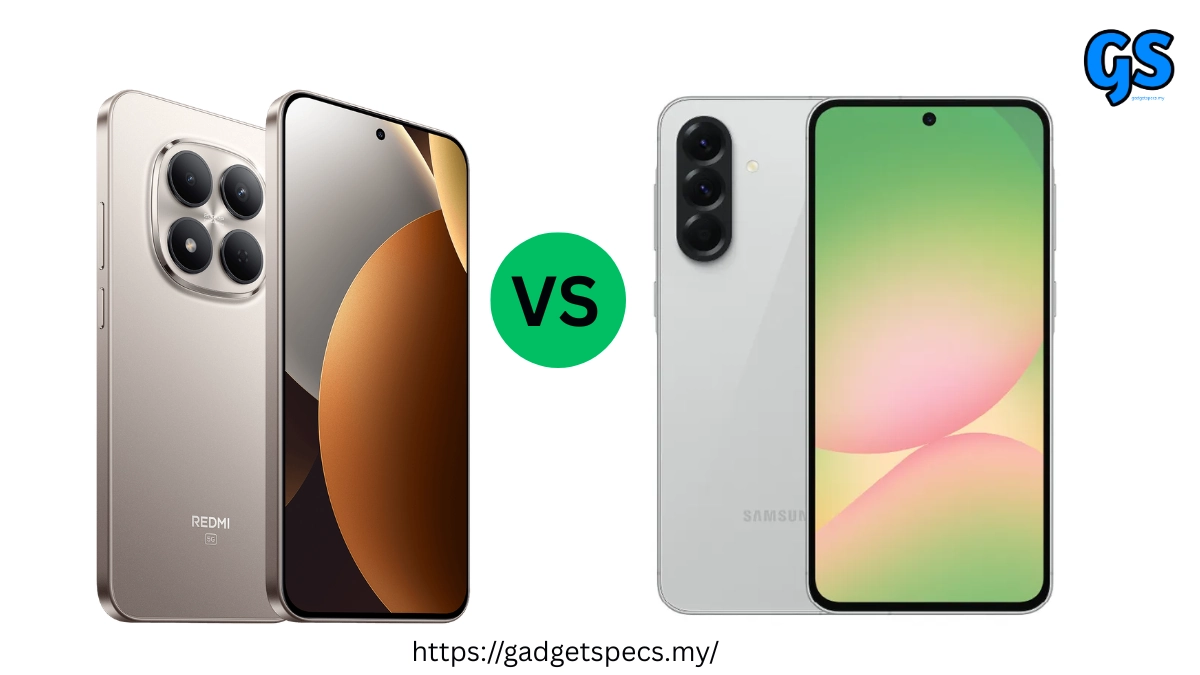
Redmi Note 15 Pro vs Samsung Galaxy A56 – Best Mid-Range Phone of 2026?
Two of the most anticipated mid-range smartphones of 2026 are finally here — the Redmi Note 15 Pro and Samsung Galaxy A56. Both devices target the RM 1,000 – RM 1,500 sweet spot in Malaysia’s incredibly competitive mid-range market, promising flagship-like features at accessible prices. But which one truly delivers better value for your money?
We’ve spent weeks rigorously testing both devices across every critical category — display quality, processing performance, camera capability, battery endurance, software experience, and build quality. Whether you’re upgrading from an older device, switching brands, or simply seeking the best mid-range phone available in Malaysia right now, this comprehensive head-to-head comparison gives you all the answers you need.
⚡ Quick Verdict
Overall Winner: Redmi Note 15 Pro — wins convincingly on specs-per-ringgit value. The Redmi Note 15 Pro delivers superior camera resolution, faster charging, larger battery, and better raw performance at a significantly lower price point. However, the Samsung Galaxy A56 fights back with superior build quality, longer software support, Samsung’s trusted brand reputation, and a more polished One UI experience preferred by many Malaysian buyers.
Price Comparison – Malaysia 2026
Price is arguably the most decisive factor when choosing between mid-range smartphones. Understanding the full pricing landscape across storage variants reveals the true value proposition each device offers Malaysian consumers.
| Variant | Redmi Note 15 Pro (RM) | Samsung Galaxy A56 (RM) | Price Difference |
|---|---|---|---|
| Base Model | RM 999 | RM 1,299 | Redmi saves RM 300 |
| Mid Variant | RM 1,099 | RM 1,499 | Redmi saves RM 400 |
| Top Variant | RM 1,199 | RM 1,699 | Redmi saves RM 500 |
Price Note: Prices are based on official Malaysian retail listings and may vary by retailer and ongoing promotions. Online platforms like Shopee and Lazada frequently offer additional voucher discounts. Always compare current prices before purchasing.
Full Specifications – Side by Side
A detailed specification comparison reveals exactly where each phone prioritizes engineering resources and which areas received cost-cutting treatment to hit target price points.
Display Comparison – Which Screen Looks Better?
Both phones feature AMOLED displays with 120Hz refresh rates — a significant step up from budget IPS LCD alternatives. However, meaningful differences in brightness and panel tuning create noticeably different viewing experiences in real-world usage.
Redmi Note 15 Pro Display
- 1,800 nits Peak: Significantly brighter for outdoor readability in Malaysian sun
- AMOLED Panel: Deep blacks, vivid colors, and excellent contrast ratio
- 120Hz Adaptive: Smooth scrolling that drops to 60Hz to conserve battery
- Gorilla Glass: Adequate front protection for daily usage
- Eye Comfort: SGS low blue light certification for extended usage
- Color Modes: Vivid and Natural modes for different preferences
Samsung Galaxy A56 Display
- Super AMOLED: Samsung’s own panel with exceptional color calibration
- 1,000 nits Peak: Adequate indoor brightness but weaker in direct sunlight
- Vision Booster: Automatic brightness optimization for outdoor visibility
- Gorilla Glass 5: Better drop and scratch protection than standard glass
- True Tone Colors: Accurate color reproduction for media and photography
- Always-On Display: Notification glancing without full wake
| Display Metric | Redmi Note 15 Pro | Samsung Galaxy A56 | Winner |
|---|---|---|---|
| Panel Type | AMOLED | Super AMOLED | SAMSUNG |
| Peak Brightness | 1,800 nits | 1,000 nits | REDMI |
| Refresh Rate | 120Hz Adaptive | 120Hz Adaptive | TIE |
| Resolution | FHD+ 2400×1080 | FHD+ 2340×1080 | TIE |
| Glass Protection | Gorilla Glass | Gorilla Glass 5 | SAMSUNG |
| Outdoor Visibility | Excellent | Good | REDMI |
| Color Accuracy | Good | Excellent | SAMSUNG |
| Always-On Display | Limited | Full featured | SAMSUNG |
Samsung’s Super AMOLED panel wins through superior color accuracy, better glass protection, and more polished Always-On Display implementation. However, the Redmi’s 1,800 nits brightness advantage is genuinely meaningful for outdoor usage in Malaysia’s sunny climate.
Performance Battle – Snapdragon 7s Gen 3 vs Exynos 1580
Processor choice fundamentally shapes the daily usage experience. The Snapdragon 7s Gen 3 and Exynos 1580 represent two different chipset philosophies targeting the same mid-range price bracket with different strengths and trade-offs.
Snapdragon 7s Gen 3 – Redmi Note 15 Pro
- 4nm Process: Efficient fabrication delivering solid performance per watt
- CPU Architecture: 4+4 core configuration optimized for balanced workloads
- GPU Performance: Adreno 710 handles gaming competently at medium-high settings
- 5G Modem: Integrated Snapdragon X62 modem for reliable 5G connectivity
- AI Engine: Hexagon processor for on-device AI photography enhancement
- Thermal Management: Efficient heat dissipation for sustained gaming sessions
Exynos 1580 – Samsung Galaxy A56
- 4nm Process: Samsung Foundry fabrication with capable performance
- CPU Architecture: 1+3+4 tri-cluster for intelligent workload management
- GPU Performance: Xclipse 540 GPU with solid mid-range graphics output
- NPU Processing: Neural processing for Galaxy AI software features
- Memory Management: One UI optimization improves real-world app fluidity
- Connectivity: Integrated 5G modem supporting Malaysian network bands
Benchmark Comparison
| Benchmark | Redmi Note 15 Pro | Samsung Galaxy A56 | Winner |
|---|---|---|---|
| Geekbench Single-Core | ~980 | ~1,050 | SAMSUNG |
| Geekbench Multi-Core | ~3,100 | ~3,200 | SAMSUNG |
| AnTuTu Score | ~780,000 | ~720,000 | REDMI |
| GPU (3DMark) | ~3,800 | ~3,500 | REDMI |
| RAM Available | 8GB / 12GB | 8GB / 12GB | TIE |
| Storage Speed | UFS 2.2 | UFS 2.2 | TIE |
| Thermal Throttling | Minimal | Moderate | REDMI |
| Daily Smoothness | Excellent | Excellent | TIE |
The Snapdragon 7s Gen 3 edges ahead through better GPU performance, superior thermal management during sustained loads, and higher AnTuTu scores. Samsung’s Exynos 1580 wins on CPU single-core tasks but falls behind in GPU and thermal sustained performance which matters most for gaming enthusiasts.
Camera Battle – 200MP vs 50MP System
Camera performance drives purchasing decisions for the majority of mid-range buyers in Malaysia. The headline 200MP vs 50MP megapixel difference creates immediate conversation, but real-world photography quality depends on far more than megapixel counts alone.
Redmi Note 15 Pro Camera System
- 200MP Main Sensor: Massive resolution enabling significant digital zoom and cropping
- f/1.69 Aperture: Wider aperture than Samsung for better low-light gathering
- OIS Support: Optical stabilization reducing blur in handheld photography
- Pixel Binning: 16-in-1 pixel binning creates bright 12.5MP default shots
- AI Enhancement: Scene detection and HDR processing across all modes
- Video: 4K at 30fps with electronic stabilization support
Samsung Galaxy A56 Camera System
- 50MP Main Sensor: Optimized sensor with superior per-pixel quality
- 12MP Ultra Wide: Significantly higher resolution wide-angle versus Redmi’s 8MP
- 5MP Macro: Better macro capability than typical 2MP sensors
- OIS Support: Optical stabilization for sharp handheld photography
- Samsung Color Science: Natural, true-to-life color reproduction preferred by many
- Video: 4K at 30fps with Super Steady mode for smooth footage
Camera Scenario Testing
| Camera Feature | Redmi Note 15 Pro | Samsung Galaxy A56 | Winner |
|---|---|---|---|
| Main Sensor | 200MP f/1.69 OIS | 50MP f/1.8 OIS | REDMI |
| Ultra Wide | 8MP f/2.2 | 12MP f/2.2 | SAMSUNG |
| Macro Camera | 2MP f/2.4 | 5MP f/2.4 | SAMSUNG |
| Selfie Camera | 16MP f/2.0 | 12MP f/2.2 | TIE |
| Low-Light Photo | Good | Excellent | SAMSUNG |
| Color Science | Vibrant | Natural | Preference |
| Digital Zoom | Excellent (200MP crop) | Limited | REDMI |
| Video Stabilization | Good EIS | Excellent Super Steady | SAMSUNG |
| Max Video | 4K @ 30fps | 4K @ 30fps | TIE |
Despite Redmi’s impressive 200MP headline, Samsung wins the overall camera comparison through superior low-light processing, better ultra-wide sensor, more capable macro camera, excellent video stabilization, and more consistent photography output across all lighting conditions. For social media creators and casual photographers, Samsung simply delivers better real-world results.
Battery Life & Charging – Who Lasts Longer?
Battery performance is critical for Malaysian users who heavily rely on mobile connectivity throughout long workdays. Both phones offer strong battery specifications, but key differences in capacity and charging speed create distinct daily usage experiences.
| Battery Metric | Redmi Note 15 Pro | Samsung Galaxy A56 | Winner |
|---|---|---|---|
| Battery Capacity | 5,500 mAh | 5,000 mAh | REDMI |
| Screen-On Time | ~11-13 hours | ~9-11 hours | REDMI |
| Video Streaming | ~20 hours | ~17 hours | REDMI |
| Wired Charging | 67W (~50 min full) | 45W (~70 min full) | REDMI |
| Wireless Charging | ❌ No | ✅ 15W | SAMSUNG |
| Charger in Box | ✅ 67W included | ❌ No charger | REDMI |
| Battery Protection | Smart charge modes | Adaptive charging | TIE |
| Standby Efficiency | Excellent | Good | REDMI |
Real-World Battery Testing Results
- Redmi Note 15 Pro: Consistently achieved 11-13 hours screen-on time during mixed usage
- Samsung Galaxy A56: Averaged 9-11 hours screen-on time under similar conditions
- Redmi Charging: 0-100% in approximately 50 minutes with included 67W charger
- Samsung Charging: 0-100% in approximately 70 minutes with separately purchased charger
- Samsung Wireless: 15W wireless charging adds convenient bedside charging option
- Charger Inclusion: Redmi including 67W charger in box provides significant added value
Redmi wins convincingly — larger 5,500 mAh battery, significantly faster 67W charging, charger included in box, and better real-world endurance testing. The only battery category Samsung wins is wireless charging availability. For practical daily usage, Redmi’s battery package delivers substantially better value and convenience.
Software Experience – MIUI 15 vs One UI 6.1
Software experience shapes daily satisfaction more than any single hardware specification. MIUI and One UI represent fundamentally different Android skin philosophies with dedicated fan bases in Malaysia’s diverse smartphone community.
MIUI 15 (Android 14) – Redmi
- Feature Rich: Extensive customization options and built-in utilities
- Second Space: Separate private profile for personal and work separation
- MIUI+ PC Connect: Mirror phone screen and use apps on Windows PC
- Sidebar: Quick access floating shortcut bar for frequent apps
- Game Turbo: Dedicated gaming mode for performance optimization
- Update Support: 3 years OS updates + 4 years security patches
- Ads Concern: Some system apps display advertisements in MIUI
- Bloatware: Several pre-installed apps that can be uninstalled
One UI 6.1 (Android 14) – Samsung
- Clean Interface: Polished, consistent design language throughout system
- Galaxy AI: Circle to Search, Live Translate, AI photo enhancement
- Modes & Routines: Powerful automation for different daily scenarios
- Privacy Dashboard: Comprehensive app permission tracking and control
- Samsung DeX: Not available on A56 but ecosystem integration strong
- Update Support: 4 years OS updates + 5 years security patches
- No Ads: Clean system without advertisement interruptions
- Minimal Bloatware: Most pre-installed apps can be removed easily
| Software Category | Redmi (MIUI 15) | Samsung (One UI 6.1) | Winner |
|---|---|---|---|
| UI Polish | Good but busy | Excellent, clean | SAMSUNG |
| Customization | Extensive | Good | REDMI |
| AI Features | Basic AI | Galaxy AI suite | SAMSUNG |
| No Ads | ❌ Some ads | ✅ No ads | SAMSUNG |
| Bloatware | Moderate | Minimal | SAMSUNG |
| OS Update Years | 3 years | 4 years | SAMSUNG |
| Security Updates | 4 years | 5 years | SAMSUNG |
| Gaming Features | Game Turbo | Game Booster | TIE |
| Privacy Controls | Good | Excellent | SAMSUNG |
One UI 6.1 wins decisively through cleaner interface design, absence of system ads, superior Galaxy AI feature integration, longer update commitment (4 years OS, 5 years security), and better privacy controls. For buyers who value software longevity and polished daily experience, Samsung’s software justifies its higher hardware price.
Build Quality & Design
Physical build quality influences durability, premium feel in hand, and resistance to accidental damage. Both phones approach mid-range build quality differently with notable trade-offs at their respective price points.
| Build Feature | Redmi Note 15 Pro | Samsung Galaxy A56 | Winner |
|---|---|---|---|
| Front Glass | Gorilla Glass | Gorilla Glass 5 | SAMSUNG |
| Back Material | Plastic | Gorilla Glass 5 | SAMSUNG |
| Frame Material | Plastic | Aluminum | SAMSUNG |
| Water Resistance | IP54 | IP67 | SAMSUNG |
| Weight | 190g | 198g | REDMI |
| Headphone Jack | ✅ Yes | ❌ No | REDMI |
| Fingerprint Sensor | Side-mounted | Under-display optical | SAMSUNG |
| USB Type | USB-C | USB-C | TIE |
Samsung wins convincingly through Gorilla Glass 5 on both front and back, aluminum frame construction, superior IP67 water resistance versus Redmi’s IP54, and premium in-display fingerprint sensor. The Galaxy A56 genuinely feels like a more expensive, premium device compared to Redmi’s plastic construction.
Complete Category Scorecard
| Category | Redmi Note 15 Pro | Samsung Galaxy A56 | Winner |
|---|---|---|---|
| Price Value | RM 999 start | RM 1,299 start | REDMI ✅ |
| Display Quality | 1,800 nits bright | Super AMOLED accurate | SAMSUNG ✅ |
| Raw Performance | Snapdragon 7s Gen 3 | Exynos 1580 | REDMI ✅ |
| Gaming | Better GPU + thermals | Good but throttles | REDMI ✅ |
| Main Camera | 200MP f/1.69 OIS | 50MP superior processing | TIE |
| Camera Consistency | Good | Excellent | SAMSUNG ✅ |
| Video Recording | Good EIS | Super Steady OIS | SAMSUNG ✅ |
| Battery Capacity | 5,500 mAh | 5,000 mAh | REDMI ✅ |
| Charging Speed | 67W (charger included) | 45W (no charger) | REDMI ✅ |
| Wireless Charging | ❌ No | ✅ 15W | SAMSUNG ✅ |
| Software Quality | MIUI 15 feature rich | One UI 6.1 polished | SAMSUNG ✅ |
| Update Longevity | 3yr OS / 4yr security | 4yr OS / 5yr security | SAMSUNG ✅ |
| Build Quality | Plastic + IP54 | Glass + Aluminum + IP67 | SAMSUNG ✅ |
| Headphone Jack | ✅ Yes | ❌ No | REDMI ✅ |
| Specs Per Ringgit | Exceptional value | Premium positioned | REDMI ✅ |
Who Should Buy Which Phone?
- Want maximum specifications at the lowest possible price under RM 1,200
- Are a student or budget-conscious buyer needing best specs per ringgit
- Need longer battery life for full day and beyond without charging anxiety
- Want 67W fast charging included with the box at no extra cost
- Prefer headphone jack for wired audio without dongles
- Enjoy gaming and need better thermal performance for sustained sessions
- Want expandable storage via microSD alongside generous internal options
- Are comfortable managing MIUI settings to disable system advertisements
- Value brand reputation and Samsung’s trusted after-sales service nationwide
- Prefer premium glass and aluminum build quality over plastic alternatives
- Want cleaner, ad-free One UI software experience without MIUI complications
- Need IP67 water resistance for better protection against accidental submersion
- Value 4-year OS and 5-year security update commitment for longer ownership
- Want wireless charging convenience for bedside or desk pad charging
- Prefer Samsung’s more natural, consistent camera output for social sharing
- Already use Samsung ecosystem devices like Galaxy Watch or Galaxy Buds
Final Verdict – Which Mid-Range Phone Wins in 2026?
🏆 Overall Winner: Redmi Note 15 Pro
The Redmi Note 15 Pro wins the overall comparison by taking 8 of 15 categories —
most critically the price, battery, charging, and performance categories that
matter most for everyday mid-range buyers. At RM 300–500 cheaper than the Samsung
Galaxy A56 with superior battery life, faster charging speed, better gaming performance,
and included charger in box, the Redmi Note 15 Pro represents genuinely exceptional
value for money in Malaysia’s competitive mid-range smartphone market.
🥈 Strong Runner-Up: Samsung Galaxy A56
The Samsung Galaxy A56 loses on price and battery but wins where it truly counts for
quality-conscious buyers — build quality, software longevity, camera consistency,
and brand reliability. For buyers who prioritize owning a premium-feeling device
with the best possible software support and consistent camera results, the Samsung
Galaxy A56 justifies every extra ringgit despite losing the overall specification battle.
Frequently Asked Questions
Which is better, Redmi Note 15 Pro or Samsung Galaxy A56?
The Redmi Note 15 Pro wins the overall comparison 8-6 categories, offering better value through superior battery, faster charging, better performance, and significantly lower pricing. However, Samsung Galaxy A56 wins on build quality, software longevity, camera consistency, and overall premium experience. Your priority determines the better choice.
What is the price difference in Malaysia?
The Redmi Note 15 Pro starts at RM 999 while Samsung Galaxy A56 begins at RM 1,299 — a RM 300 gap at entry level widening to RM 500 at higher storage tiers. Additionally, Redmi includes a 67W charger in the box while Samsung ships without a charger, making the real-world value difference even more significant.
Which has better camera quality?
Samsung Galaxy A56 wins the camera comparison overall through superior low-light photography, better ultra-wide sensor, more natural color science, and excellent video stabilization. The Redmi Note 15 Pro’s 200MP sensor enables impressive digital zoom and detail capture in daylight but produces less consistent results across all lighting conditions.
Which phone has longer software support?
Samsung Galaxy A56 wins decisively — offering 4 years of OS updates and 5 years of security patches. The Redmi Note 15 Pro provides 3 years of OS updates and 4 years of security patches. For buyers planning to keep their phone 3-4 years, Samsung’s longer commitment provides meaningful additional value.
Which has better battery life?
Redmi Note 15 Pro wins clearly — larger 5,500 mAh battery achieves 11-13 hours screen-on time versus Samsung’s 9-11 hours from its 5,000 mAh battery. Furthermore, Redmi’s 67W charging (charger included) completes a full charge in 50 minutes versus Samsung’s 45W taking 70 minutes without an included charger.
Is Samsung Galaxy A56 waterproof?
The Samsung Galaxy A56 features IP67 rating providing full protection against submersion in up to 1 meter of water for 30 minutes. The Redmi Note 15 Pro carries only IP54 rating offering splash resistance but not full submersion protection. For water resistance, Samsung clearly wins this category.
Which is better for gaming?
Redmi Note 15 Pro performs better for gaming through Snapdragon 7s Gen 3’s superior GPU performance, better thermal management reducing throttling during extended sessions, and dedicated Game Turbo mode. Samsung’s Exynos 1580 handles casual gaming well but shows more performance throttling during prolonged demanding gaming sessions.
Should I buy Redmi Note 15 Pro or save for Samsung A56?
If budget is genuinely tight, the Redmi Note 15 Pro at RM 999 delivers outstanding specifications and should not be considered a compromise choice. However, if you can comfortably afford Samsung’s RM 1,299 starting price, the premium build quality, cleaner software, longer updates, and better camera consistency genuinely justify the additional investment for many Malaysian buyers.


One Comment