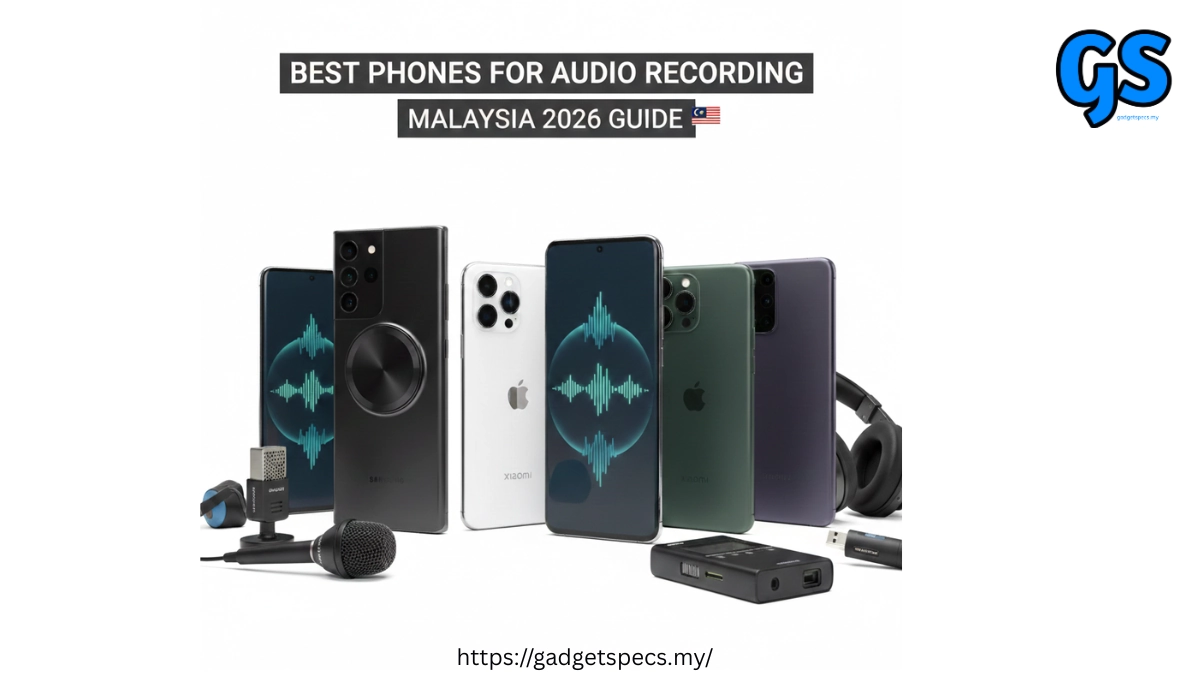
Best Phones for Audio Recording in Malaysia – 2026 Guide
Whether you’re a podcaster recording interviews, a musician capturing song ideas, a journalist conducting field recordings, or a content creator filming vlogs — audio quality can make or break your content. While modern smartphones pack impressive cameras, their built-in microphones often remain an afterthought. But some phones stand out with multi-microphone arrays, advanced noise cancellation, and directional audio capture that genuinely rival entry-level dedicated recorders.
In this comprehensive guide, we rank the best phones for audio recording available in Malaysia in 2026 — from flagship devices with studio-grade mic setups to budget options that punch above their weight. We also cover the best external microphones you can pair with your phone, key features to look for, and real-world audio quality comparisons. If clear, professional sound matters to your work, this guide will help you choose wisely.
Quick Answer: Best Phone for Audio Recording in Malaysia?
For overall audio recording quality, the Apple iPhone 17 Pro leads with its 4-microphone array, directional audio capture, and best-in-class wind noise suppression. For voice clarity and background noise rejection, the Samsung Galaxy S25 Ultra delivers the fullest, clearest audio capture. For fuller bass tones in speech, the Google Pixel 10 Pro excels. And for the best value option with decent mic quality under RM3,000, the Xiaomi 14T Pro offers surprisingly good audio capture at a fraction of flagship prices. Pair any of these with an external mic (Rode VideoMic Me, Shure MV88+, or wireless lav systems) for professional results.
Apple iPhone 17 Pro / Pro Max 4-Mic Array
The iPhone 17 Pro and Pro Max feature Apple’s most advanced audio recording system ever — a 4-microphone array with directional audio capture, Centre Stage audio focus, and industry-leading wind noise suppression. In direct audio comparisons against the Samsung S25 Ultra and Google Pixel 10 Pro, the iPhone consistently delivers the smoothest, most balanced audio across different recording scenarios.
Audio Recording Strengths:
- Directional Audio Capture: The 4-mic array intelligently focuses on voices directly in front of the phone, reducing background noise
- Best Wind Noise Suppression: Superior wind rejection compared to Samsung and Google — critical for outdoor recording
- Smooth Stabilization: Class-leading video stabilization extends to audio — less handling noise and vibration rumble
- Centre Stage Audio: Automatically keeps audio balanced when the subject moves in frame during one-person vlogs
- Multi-Camera Audio Sync: When recording with both front and rear cameras simultaneously (Dual Recording), audio stays perfectly synced
- ProRes Recording: Capture uncompressed audio alongside video for professional post-production workflows
Samsung Galaxy S25 Ultra Best Background Noise Rejection
The Samsung Galaxy S25 Ultra delivers the fullest, clearest audio capture among all flagship phones tested in 2026. In direct video recording comparisons, reviewers noted that the S25 Ultra produces the best background noise suppression against wind and environmental sounds while maintaining excellent voice clarity. This makes it particularly strong for interviews and podcasts recorded in noisy environments.
Audio Recording Strengths:
- Best Background Noise Suppression: Tested as the strongest at rejecting wind and ambient noise while preserving voice clarity
- Fullest Voice Capture: Produces rich, full-bodied voice recordings with excellent midrange presence
- AI Audio Enhancement: Galaxy AI improves audio quality in post-processing automatically
- Log Recording Audio: Capture flat audio profiles for professional colour grading workflows
- 8K Video Recording: High-resolution video with matching high-quality audio capture
Google Pixel 10 Pro / Pro XL 8K Video Boost
The Google Pixel 10 Pro and Pro XL stand out for capturing fuller bass tones in speech compared to the iPhone and Samsung. This gives voices a warmer, more podcast-studio feel. The trade-off is slightly less aggressive wind noise suppression than the iPhone, but many creators prefer the Pixel’s more natural, less processed audio signature.
Audio Recording Strengths:
- Fuller, Warmer Voice Tones: Captures more bass in speech — voices sound richer and more natural
- 42MP Front Camera: Highest-resolution selfie camera with matching high-quality audio for vlog recording
- Video Boost: Cloud processing enhances both video clarity and audio stability for professional results
- 8K Recording Option: Upload to Google’s cloud to unlock 8K @ 30fps with enhanced audio processing
- Less Aggressive Processing: Audio sounds more natural and less “AI-smoothed” compared to competitors
Xiaomi 14T Pro Under RM3,500
For creators on a budget, the Xiaomi 14T Pro delivers surprisingly capable audio recording at a fraction of flagship prices. While it doesn’t match the iPhone or Samsung’s mic arrays, it handles everyday recording tasks well and supports external mic connections via USB-C for serious work.
Quick Comparison: Built-In Microphone Quality
| Phone | Mic System | Best Audio Feature | Price (RM) |
|---|---|---|---|
| iPhone 17 Pro | 4-mic array | Best wind noise suppression | 7,499+ |
| Samsung S25 Ultra | Multi-directional | Best background noise rejection | 5,499+ |
| Google Pixel 10 Pro | Multi-mic AI | Fuller bass in voice capture | 5,199+ |
| Xiaomi 14T Pro | Dual-mic | Best value with external mic support | 3,299+ |
Best External Microphones for Phones in Malaysia
Even the best built-in phone microphones can’t match a dedicated external mic. Here are the top options available in Malaysia across different budgets and use cases:
Best Shotgun Microphones (Directional):
| Microphone | Connection | Best For | Est. Price (RM) |
|---|---|---|---|
| Rode VideoMic Me | 3.5mm TRS | Vlogging, on-camera recording | ~200–300 |
| Shure MV88+ | USB-C / Lightning | Professional recording, adjustable patterns | ~900–1,100 |
| Rode NT-USB Mini | USB-C | Podcasting, voiceovers, interviews | ~500–650 |
| Movo VXR10 | 3.5mm TRS | Budget shotgun, video recording | ~150–250 |
Best Lavalier (Clip-On) Microphones:
| Microphone | Type | Best For | Est. Price (RM) |
|---|---|---|---|
| Rode smartLav+ | Wired lav | Interviews, presentations | ~300–400 |
| Maono AU100 | Wired lav | Budget option, multi-device compatible | ~80–150 |
| Shure MoveMic 88+ | Wireless lav | Professional wireless, 4 polar patterns | ~1,200–1,500 |
| SYNCO G1T/G1L | Wireless lav | Live music, singing vlogs, ASMR | ~500–700 |
What to Look For in a Phone for Audio Recording
1. Number of Microphones
More microphones = better directional audio and noise cancellation. Flagship phones typically have 3–4 mics positioned around the device. Budget phones usually have 1–2 mics, which limits spatial audio capture.
2. Wind Noise Suppression
Critical for outdoor recording. The iPhone 17 Pro leads here, followed by the Samsung S25 Ultra. Test by recording outdoors on a windy day — check if voices stay clear or get drowned out by wind rumble.
3. Background Noise Rejection
Important for recording in noisy environments (cafés, streets, events). The Samsung S25 Ultra excels at isolating voices from background chaos.
4. Audio File Format Support
Professional creators need uncompressed or lossless audio formats. iPhone supports ProRes and Apple Log 2. Samsung offers Log recording. Most Android phones compress audio heavily — check if your preferred recording app supports higher-quality formats.
5. External Mic Compatibility
All modern phones support external mics via USB-C or 3.5mm jack (with adapter). Ensure your phone recognizes external mics automatically without needing special drivers.
Explore More Content Creation & Photography Guides
If audio recording is part of a broader content creation workflow, these guides will help you choose the right equipment:
- Best phones for video editing & mobile filmmaking in Malaysia — if you’re editing video on your phone after recording, this guide ranks phones by processing power and display quality
- Best phones for content creators & influencers in Malaysia — optimised for social media creation, vlogging, and reels
- Best camera phones for photography lovers in Malaysia — comprehensive camera phone ranking including video and audio quality
- Best wireless earbuds for smartphones in Malaysia — for monitoring audio quality while recording on location
Also, if you’re interested in the overall best phones available right now (considering all factors, not just audio), check our comprehensive guide on the best smartphones of the year in Malaysia.
Frequently Asked Questions
Which phone has the best built-in microphone for recording?
The Apple iPhone 17 Pro has the best overall built-in microphone system thanks to its 4-mic array, directional audio capture, and superior wind noise suppression. For voice clarity in noisy environments, the Samsung Galaxy S25 Ultra delivers the fullest, clearest audio with best-in-class background noise rejection.
Do I really need an external microphone?
If audio quality is critical to your work — yes, absolutely. Even a RM200 external mic (like the Rode VideoMic Me) will deliver dramatically better results than any built-in phone mic. For casual social media content, built-in mics on flagship phones are usually sufficient.
What’s the best budget phone for audio recording?
The Xiaomi 14T Pro at RM3,299 offers the best value for audio recording in the mid-range segment. It supports external mics via USB-C and delivers decent built-in mic quality for everyday content creation.
Can Android phones match iPhone audio quality?
In some areas, yes. The Samsung S25 Ultra actually surpasses the iPhone in background noise rejection and voice clarity. The Google Pixel 10 Pro captures fuller bass tones in speech. However, the iPhone’s 4-mic array and wind noise suppression remain best-in-class. It depends on your specific recording needs.
What external mic should I buy for podcasting on my phone?
For podcasting, a USB-C connected mic like the Rode NT-USB Mini (RM500–650) or Shure MV88+ (RM900–1,100) delivers studio-quality results. For interviews where you need mobility, a wireless lav system like the SYNCO G1T (RM500–700) gives you flexibility while maintaining excellent voice capture.
Final Verdict: Best Phone for Audio Recording in Malaysia
Best Overall: Apple iPhone 17 Pro (from RM7,499)
The 4-microphone array with directional audio capture and superior wind noise suppression makes this the most
reliable phone for audio recording across all scenarios. Best choice for professional vloggers, YouTubers, and
journalists who can’t afford audio failures in the field.
Best Voice Clarity: Samsung Galaxy S25 Ultra (from RM5,499)
Delivers the fullest, clearest audio with the best background noise rejection. Ideal for podcasters and
interviewers recording in challenging acoustic environments. Slightly more affordable than the iPhone while
matching or exceeding its audio quality in specific scenarios.
Best for Natural Voice Tones: Google Pixel 10 Pro (from RM5,199)
Captures fuller bass in speech for warmer, more natural-sounding recordings. Best for podcast-style content
where voice quality matters more than aggressive noise suppression. Just watch out for the microphone position
quirk when filming in landscape.
Pro Tip: Always Use an External Mic for Serious Work
No built-in phone mic — even on the iPhone 17 Pro — can match a dedicated external microphone. If audio is
truly critical to your content, budget RM200–1,000 for a proper external mic (Rode, Shure, SYNCO). Your audio
quality will jump dramatically.